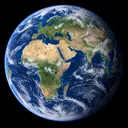
Explore the solar system, from the planets and their moons to asteroids and comets. Compare their sizes and orbits, change an object’s speed, or follow a model journey to another planet.
Learning guide
What you’ll learn
Compare planetary motion and explain how gravity and speed shape an orbit.
What to change
Choose a planet, change orbital speed, or select a model journey.
What to observe
Compare orbit size, time to complete an orbit, and changes in speed.
Why it happens
Gravity continually changes an orbiting object’s direction. Its position and velocity determine its path.
Teacher notes
Learning objective: Describe one observed pattern and explain it using gravity or orbital motion.
Suggested ages: 9–14. Adapt the activity to your group.
Suggested duration: 10–15 minutes for one activity.
Prerequisite knowledge: Recognize the Sun, planets and moons, and distinguish a planet from a moon.
Common misconception: Orbiting objects experience no gravity. Gravity continually changes their direction of motion, keeping them in orbit.
Sources: Read our methods and data sources and the sources on each linked activity.
Model limitations: Previews simplify sizes, distances and motion. The solar-system thumbnail uses illustrative positions rather than the planets’ current positions. Model journeys illustrate orbital mechanics; they are not mission schedules. Check each activity’s assumptions before using it for measurements.
Lesson status: These are exploration activities. Ages and durations are suggestions, not classroom-tested results. Lesson development and unfinished drafts are separate.
Watch the four inner planets orbit the Sun. Compare how quickly they complete an orbit. This preview illustrates their motion; it does not show their current positions.
How were the planets formed? The planets formed from gas and dust around the young Sun.
At this speed, the moon follows a circular orbit.
Change the moon’s speed and compare the orbit’s shape. Watch how its speed changes as it moves closer to or farther from the planet.
Why planets don't fall into the sun →How does an orbit work? Change the Moon’s speed and watch how its orbit changes.
Explore the eight planets in order from the Sun. Compare their sizes, rotation and moons, then investigate dwarf planets, asteroids and comets.
All the planets, side by side →Watch the Moon orbit Earth as Earth travels around the Sun. Change the viewing angle to compare the two orbits.
Explore model journeys to Mars, Jupiter and Saturn. Compare departure opportunities, travel times and the changes in speed each journey requires.
Rocket launches & launch windows →Choose a location and time to explore the Sun’s and Moon’s positions in the sky.
Phobos laps Deimos about 4.0 times over — 7.7 hours against 1.3 days. The preview uses orbital data, but the moons’ positions are illustrative.
2 confirmed moons · 2 drawn
Mars and its moons →Metis laps Callisto about 57 times over — 7.1 hours against 17 days. The preview uses orbital data, but the moons’ positions are illustrative. 9 outer moons are outside this view.
97 confirmed moons · 8 drawn
Jupiter and its moons →Why do planets have moons, and how are they made? Moons can form beside a young planet, gather from debris after a large collision, or be captured from elsewhere.
Pan laps Hyperion about 37 times over — 14 hours against 21 days. The preview uses orbital data, but the moons’ positions are illustrative. 8 outer moons are outside this view.
274 confirmed moons · 22 drawn
Saturn and its moons →Cordelia laps Oberon about 40 times over — 8.0 hours against 13 days. The preview uses orbital data, but the moons’ positions are illustrative. 5 outer moons are outside this view.
28 confirmed moons · 18 drawn
Uranus and its moons →Naiad laps Triton about 20 times over — 7.1 hours against 5.9 days. The preview uses orbital data, but the moons’ positions are illustrative. 4 outer moons are outside this view. Triton goes round backwards.
16 confirmed moons · 8 drawn
Neptune and its moons →Charon laps Hydra about 6.0 times over — 6.4 days against 38 days. The preview uses orbital data, but the moons’ positions are illustrative.
5 confirmed moons · 5 drawn
Pluto and its moons →Keep exploring the solar system, planets and moons, gravity and orbits, and space exploration. Or jump across: All · Earth · Time.