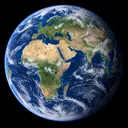
See how Earth’s motion shapes day and night and the seasons. Explore the Moon’s phases and tides, or choose a location to check sunrise, sunset and Moon times.
Learning guide
What you’ll learn
Explain how Earth’s rotation, its tilted axis and the Moon’s motion affect daylight, seasons, Moon phases and tides.
What to change
Choose a date or location in one of the linked activities.
What to observe
Compare daylight duration, the Moon’s illuminated shape, or the timing and height of tides.
Why it happens
Earth’s rotation causes day and night. Its tilted axis changes seasonal sunlight as Earth orbits the Sun. The Moon’s orbit changes the amount of its sunlit half we can see. The Moon’s and Sun’s gravity cause tides.
Teacher notes
Learning objective: Describe one observed pattern and explain its cause using Earth’s motion, the Moon’s motion or gravity.
Suggested ages: 9–14. Adapt the activity to your group.
Suggested duration: 10–15 minutes for one activity.
Prerequisite knowledge: Earth rotates on its axis and orbits the Sun.
Common misconception: Earth’s shadow causes ordinary Moon phases. Phases arise because we see different amounts of the Moon’s sunlit half; Earth’s shadow causes a lunar eclipse.
Sources: NASA explains seasons and Moon phases. NOAA explains tides. Read our methods and data sources for individual tools.
Model limitations: Illustrations simplify sizes, distances and motion. The seasons diagram compares two solstice positions, viewed edge-on, with the same axis direction. Check each activity’s limitations before using it for measurements.
Lesson status: These are exploration activities. Ages and durations are suggestions, not classroom-tested results. Lesson development and unfinished drafts are separate.
Can the moon be up in the daytime? The Moon can be above the horizon during daylight as well as at night.
Sunrise & Sunset
The cities below run north to south. The farther from the equator, the more day length swings with the season — long summer days, short winter ones.
Two positions in Earth’s orbit, viewed edge-on. The horizontal line marks the orbital plane; the vertical guides are perpendicular to it. Sizes and distances are not to scale.
Earth carries the same 23.4° tilted axis around the Sun. That tilt changes the angle of sunlight and the hours of daylight, giving the hemispheres opposite seasons.
What is a solstice? A solstice marks the longest or shortest day of the year in each hemisphere.
What is an equinox? An equinox is the moment the Sun crosses Earth’s equator, around March and September.
Why does the Moon change shape? As the Moon orbits Earth, we see different amounts of its sunlit half.
Where the sun and moon are from your town, at any moment.
What is a synodic month? The Moon orbits Earth in about 27.3 days, while its phases repeat about every 29.5 days.
Why does moonrise get later each night? Moonrise usually gets later because the Moon moves eastward in its orbit while Earth spins.
What is tidal locking? The Moon rotates once per orbit, so roughly the same side faces Earth.
What causes tides? Compare predicted tide heights and times at three coastal locations.
Keep exploring day and night, seasons, Moon phases and tides. Or jump across: All · Space · Time.